Saturday, 9 April 2016

How To Find Morel Mushrooms

This is a quick video to show you some of the basics of Morel hunting. In this video, they will talk you through the difference between the two different varieties of Morel Mushroom (Grays & Yellows), and provide some valuable advice on how and where to find them.

Source: Elifestylellc from Youtube


Leave a Reply

Tuesday, 5 January 2016

Guide to mushroom keys

Few keys to ID fungi:
http://ift.tt/1VHtRc0 General key to Agaricales and Boletaceae

http://ift.tt/1Rr0dqX General key
__________________________________________________________

http://ift.tt/1VHtSww Key to Agaricus

http://ift.tt/1Rr0b2u Site about amanitaceae by Tulloss

http://ift.tt/1VHtSwy key to Armillaria by Watling

http://boletales.com/ Site about Boletales by Boris Assyov

http://ift.tt/1Rr0dr3. Key to Cantharellus

http://ift.tt/1VHtRc2 Key to Clavarioid fungi to Genera

http://ift.tt/1Rr0biK Key to Clavulina

http://ift.tt/1VHtRc6 Key to Collybia s.l.

http://ift.tt/1Rr0dr7 Site about Coprinus s.l. by Uljé

http://ift.tt/1VHtRc8 Key to Conocybe by Orton

http://ift.tt/1Rr0biP Key to Corticiaceae

http://ift.tt/1VHtRca Cortinarius I by Orton

http://ift.tt/1Rr0biV Cortinarius II by Orton

http://ift.tt/1VHtSwF Key to Cup fungi pt1 by Spooner

http://ift.tt/1Rr0biX Key to Cup fungi pt2 by Spooner

http://ift.tt/1VHtSwH Key to Cup fungi pt3 by Spooner

http://ift.tt/1Rr0biZ Key to Cup fungi pt4 by Spooner

http://ift.tt/1VHtSwJ Key to Daldinia

http://ift.tt/1Rr0eeo key to Cortinarius subgenus Dermocybe

http://ift.tt/1VHtSwM Key to Cortinarius subgenus Myxacium by Geoffrey Kibby

http://ift.tt/1Rr0dHp Key to Deconica

http://ift.tt/1Rr0ees Dung fungi by Watling&Richardson

http://ift.tt/1VHtRss key to Entoloma by Noordeloos

http://ift.tt/1Rr0eey Key to Entoloma subgenus Leptonia

http://ift.tt/1VHtRsu key to Flammulina

http://ift.tt/1VHtRsw Key to Galerina

http://ift.tt/1Rr0eeE Keys to Geastraceae but also Lyophyllum,Helvella,Elaphomyces, etc.

http://ift.tt/1VHtSwO key to Geopora by Dougoud

http://ift.tt/1Rr0dHv Key to Gymnopilus

http://ift.tt/1VHtSN4 Key to Hebeloma sect denudata

http://ift.tt/1VHtSN6 Key to Hebeloma sect Theobromina

http://ift.tt/1Rr0dHz Key to Hygrocybe By Leonard

http://ift.tt/1VHtRsC Key to Hygrophorus

http://ift.tt/1Rr0euY key to Inocybe

http://ift.tt/1VHtSN8 Key to Laccaria

http://ift.tt/1VHtRsI Key to Lactarius By Leonard & McAdam

http://ift.tt/1Rr0ev3 to Lactarius sect. deliciosi

http://ift.tt/1Gd4Sta Key to Leccinum by Geoffrey Kibby

http://www.mycena.no/ site and key to Mycena By Aronsen

http://ift.tt/1Rr0ev7 Key to Naucoria
http://ift.tt/1Rr0evb Key to Naucoria by PAM

http://ift.tt/1Rr0dXT Key to Otidea

http://ift.tt/1VHtUoa Key to Paxillus

http://ift.tt/1Rr0dXV Key to Peziza

http://ift.tt/1VHtSNg Key to Phellodon

http://ift.tt/1VHtSNi Key to Pholiota

http://ift.tt/1Rr0eLs Key to Plectania

http://ift.tt/1VHtUoc Key to Pluteus by Iliffe

http://ift.tt/1Rr0dXZ Key to Pluteus sect. pluteus

http://ift.tt/1VHtUoe wood rotting bluing Psilocybe key

http://ift.tt/1Rr0dY2 Key to Psathyrellaceae and coprinoid fungi by
Melzer

http://ift.tt/1Rr0eLw Key to Ramaria

http://ift.tt/1VHtUog Key to Rhodocybe

http://ift.tt/1Rr0eLA Key to Blackening Russula by Geoffrey Kibby

http://ift.tt/1Rr0dY4 Key to Xerocomus s.l. by Hills

British mycology mushroom identification key.

Growing Morel Animation

I made this cure morel growing animation!

Tuesday, 17 March 2015

Angies Birthday Treasure Hunt to the Rising Sun

So on the 14th of March, 10 intrepid adventures set off in pursuit of treasure. All that was given was a map and a trusty mobile phone by which they were to receive clues.


They were asked to meet at Liverpool Street Station and wait further instruction. They were met by Angie and guided to the start point at St Botolph without - Bishopsgate where they received...


...the first clue.

"Maude spies through the keyhole to the south facing dagger. It points to the crescent equation to which you must endeavour. "


To find Maude a little searching was required. Maude could be found to the left of the image next to a decorative water fountain.


Once Maude was found you can proceed to the next part of the clue "spies through the keyhole to the south facing dagger". If you stood where the wife of the Reverend was remembered and looked through the keyhole you would see a south facing dagger pointing to the crescent equation.


The dagger points to a club called the DollHouse.


Looking around the DollHouse our adventures found an equation under the crescent moon ontop of the DollHouse which had "3x4" the answer to which was 12.  Once this answer was text to the quiz master the next clue was sent...

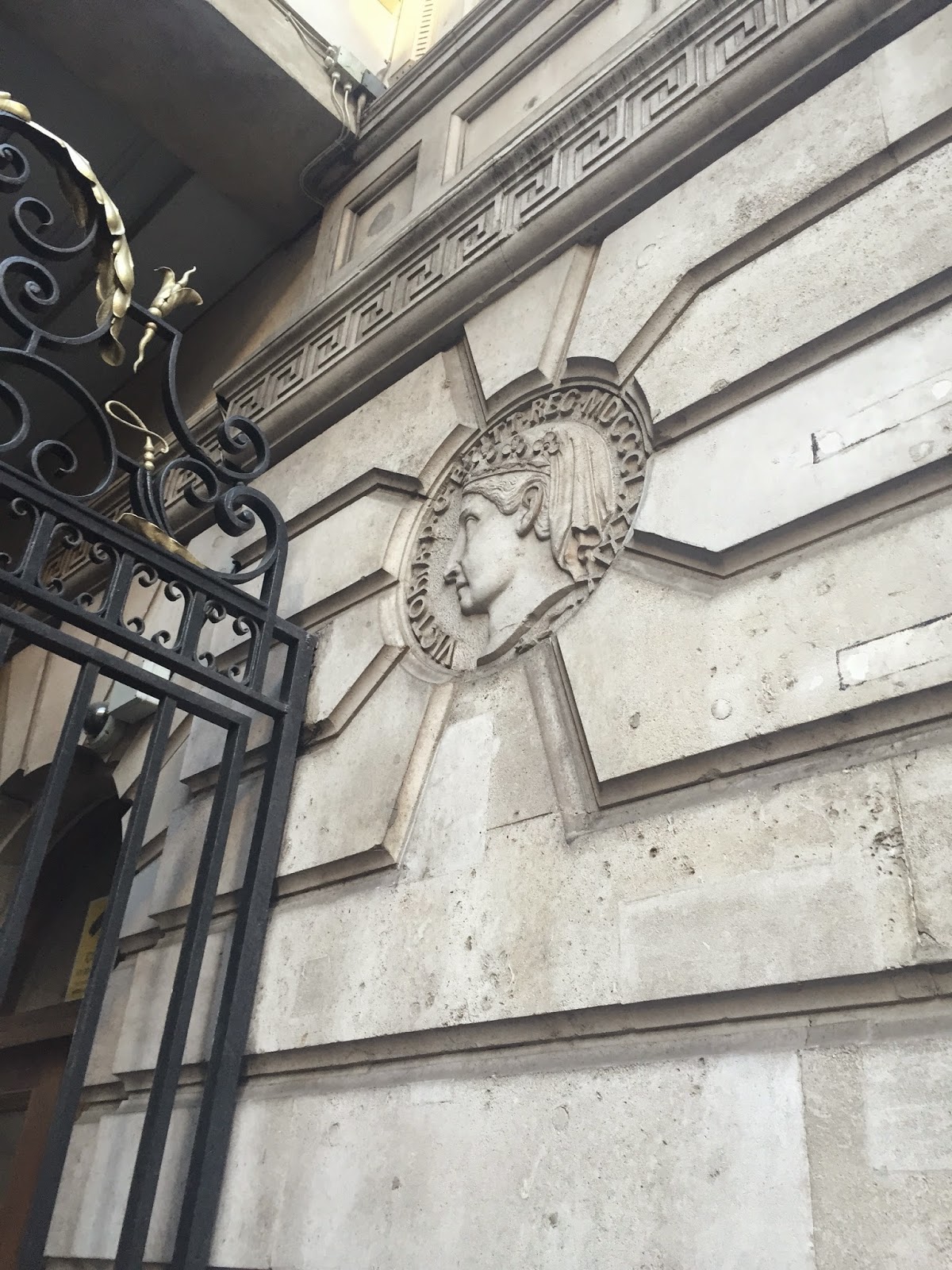
"Along the Wall you must walk until Rome has been burnt by an emperor then honour his God by proceeding. Tell me how many lamps the Empress of India is spying."

Our adventurers immediately recognised that the emperor and Rome reference was Nero, there was a Cafe Nero on the London Wall close to the DollHouse so this is where they went. Next to The cafe they found an archway which they entered...


Once god was honoured the Empress could be found here...


At the time (Saturday 3pm) the gate was closed.


The trick here was not to count all of the lamps, but to stand directly underneath the Empress and see as she saw. If you stand on the opposite side of the gate you can only see 6 lamps, if you stand directly underneath her you will see 7. Which is the answer which unlocks the next clue.

"Follow the Wall past the circus and Charter to Angies profession, count the number of wings on the swans in the alley. "

To answer this you needed to know that Angie is an accountant. About 100m from the Empress was a sign saying "Institute of Chartered Accountants".


This took you to the Institute which was located on Great Swan Alley.


When making the Hunt we thought to ask the hunters to count all of the Wings on Swans Alley, we counted all of them (we got to 40 something) when we got to the end of the street we burst out in laughter and changed the clue to count the number of wings on the swans in the alley, the answer was 2. 

"At the end of the alley, bare right and follow the light of the house to the globe and run with the dexter fox towards the reverend black. By the ONE London wall you will find the medieval wall which leads you to the secret garden, smell Irises perfume and ask her for her neighbours number. If you are unsure, follow the down pour, where you will find the map confirming the cipher."

Some of the treasure hunters headed the other way at this point but came back after a while. The other team recognised the Globe as a famous pub close to the location and headed in the right direction. This took them down Moorgate back to the wall. None of the teams picked up on the "light of the house" part. This clue was put to help them reaffirm they were going in the right direction, if they looked closely they would have seen...


Its pretty tricky to see, but if missed the idea was that you could pretty much see the Globe at the end of the street (just by the bus on the left).


Once you got to the Globe next door is the Fox. There are two foxes on the sign, the sinister one pointing right and the dexterous one pointing to the left. To confirm this clue the Reverend Black was added which was supposed to be a clue to head to Black Friars which is up the Wall.

"By the ONE London wall..." 


"...you will find the medieval wall..."


There aren't photos of the Garden but behind the wall to the right of the picture was a botanical garden with medicinal herbs. When looking for the next number we looked high and low for a number, each plant had a plaque with some historical/botanical details. Next to the iris flower was a flower which was planted in the 15 century. We were hoping at this point our adventurers would cotton on to the fact that each clue resulted in a number and possibly would start to question why...

If that was too difficult an extra clue was given here... "follow the down pour..." behind the garden was a fountain next to which was this map...


The answer was 15, the final clue was then sent...

Walk to the end of the Wall and up the northern road to find Thomas Moore. Ask him about the lonely Knight protecting the passage through the forest. Find the Knight standing guard next to his helmet and follow the passage to a Knight lined road. Find another helmet less Knight and solve the riddle:

This thing all things devours;
Birds, beasts, trees, flowers;
Gnaws iron, bites steel;
Grinds hard stones to meal;
Slays king, ruins town,
And beats mountain down.

Opposite this, you will find a number by which this word rhymes, this is your first clue to the final answer.

Look for the white dragon in the sky salivating on his yellow prey, instead run towards the rising sun casting a shadow upon Angies Castle.

The last part to this tale, is for you to recount and give the barkeep a final number to surmount. 

This was pretty bloody cryptic, we thought to give a really hard one for them all to think for about for a while and build up their thirst for their potential reward. 

The beginning of the clue is pretty straight forward, although it required a bit of geographical knowledge in finding the northern road from the round about although the map should have helped. Going up the road you come across Thomas Moore house, opposite to which was this fella...


As this was a little difficult to fathom we added the clue with his helmet...


This was on "Braid Wood Passage" which should have given them a little clue. Where our adventurers got really stuck was the last part of the clues and in retrospect we could have made it easier for them. At this point we knew that both teams were going to convene as they got the last clue pretty sharpish.


We tried to roll with the idea of Knights as the road was called King Horn street which we though appropriate. If you get to the end of this road there is another "helmetless knight" (a bollard without a conical top) which was underneath a sundial which was supposed to represent "time" which is the answer to the riddle. Opposite the sundial was a sign saying established in 1979 which was Angies birthday. Lastly on this corner, if they looked up to the sky they would have seen...


The White Dragon, this was more apparent on the day and from the "head" of the crane was a wire which was attached to a yellow hook, which looked like the dragon was salivating on its yellow prey. Looking to the right our adventurers could see...


Angies Castle in the Shadow of the Rising Sun. At this point as per the last line of the clue (barkeep) they should have realised they were looking for a bar or pub. At this point it was our intention that they would sit in the bar and figure out a final guess to the clue in relation to their guesses which were...

12, 7, 2, 15 and 1979.

12 + 7 +2 +15 = 36 (it was Angies 36th birthday) and 1979 was the year she was born.

We instructed the barkeep to be a straight faced as possible until the number was said upon which he instructed them to go upstair where they would find...


 Happy Birthday Angie!


Wednesday, 5 November 2014

Amarilla

Any suggestion what this might be? (I know its a mushroom). It was found on Hampstead Heath, London, UK.


Monday, 7 July 2014

Dryad's Saddle

Interesting, understated mushroom.

  • Grows on trees.
  • Has a porous underside much like a bolette.
  • Usually found May to June.
  • Younger specimens are better than older.
From a differential point of view, Dryad's saddle can be confused with other polypores, however its distinctive top, porous underside and "meatiness" (polypores have a woody texture) make it pretty distinctive.

Wednesday, 9 April 2014

The Foolproof Four

"The Foolproof Four" are four excellent species to begin with. Their characteristics are easily identified, and easy to remember. The Foolproof Four are: 
  • Morels
  • Chicken Mushroom
  • Chanterelles
  • Puffballs. 


I usually add Oysters and Hen of the Woods or a general bolete.

Get two good field guides, before you go out learn how to use them and read through them to familiarize yourself with their use.

Sunday, 6 October 2013

Whats the difference between Chlorophyllum rhacodes and Chlorophyllum molybdites?

One is a poisonous mushroom the other is a common and tasty mushroom, but which is which?

Chlorophyllum rhacodes, commonly known as the shaggy parasol is a common edible mushroom mainly found in Europe.

Chlorophyllum rhacodes - Shaggy Parasol
Its pretty common and can be readily identified:

  • The most distinct characteristic is size, these mushrooms can be up to a foot tall, and there parasol top is huge.
  • Secondly, the distinctive cap. Its "shaggy" appearance comes from flaked dark skin on the top of the mushroom exposing a lighter colour underneath.
  • Thirdly, they have brown spores, NOT green which will become important later on in this article.
These mushrooms a deemed safe for new mycologists in Europe as the main mushroom that can be confused which is poisonous only occurs in the US, although there has been one report in a greenhouse in Scotland. This is Chlorophyllum molybdites, (or false parasol) the most commonly consumed poisonous mushroom in temperate areas of North America. The main difference is the development of green spores after a spore print and a greenish hue to the colour of the cap.

Chlorophyllum molybdites - False Parasol
The above picture is the only one we could find of the False Parasol, however it looks almost indistinguishable. Therefore, if you pick a parasol in EU or US, best to do a spore print to look for the development of green spores.

Thursday, 3 October 2013

How to identify bolete mushrooms

Boletes are readily recognisable as the do not have gills, but little spore holes on the underside of the cap. You probably have seen them before but called Porcini or Penny Bun mushrooms. The most common boletes to look out for are:

Two Colour Bolete
And

Old Mans Bolete

Most boletes are edible. How to spot a poisonous bolete: 
  • The under side of the cap is blood red
  • The top of the cap is pure white (this would be a devils bolete) 
  • They DO NOT turn blue when bruised

Uk Mushroom Hunt

Beautiful Bunch of Mushrooms - Dave Gillepsie, http://reactivist.co.uk/
Hmm... from left to right, clockwise.
  • Devils boletes - no gills, yellow underneath, red stalk, however brown on top, Devils Bolletes are usually white on top.
So what is it? Could be http://en.wikipedia.org/wiki/Boletus_calopus however, these are inedible. Hmm...
  • Shaggy Parasol Mushrooms - Chlorophyllum rhacodes, pretty common.
  • Beef Steak Mushroom - found on an Oak tree.


Thursday, 18 July 2013

Mushroom Exam Website

Would you like to learn how to identify mushrooms which are edible? Do you want to know what the top toxic mushrooms are to avoid? Why not join up to our online mushroom course website?

Wednesday, 17 July 2013

Storing morel mushrooms in the refrigerator

Storing morel mushrooms in the refrigerator 

There are a number of procedures that one may take in preparing morel mushrooms for storage. 
  • The first of those is to clean the mushrooms then wrap them in a damp towel or cloth and store them in the fridge.
  • The second way is most common in Missouri. After the morel mushrooms have been cleaned, they are placed in half filled plastic containers with water. The containers are closed with a lid and refrigerated. Depending on the person, the end result for the morel mushrooms could be mushy but again for others it serves right. 
  • The third way consists of storing the morel mushrooms as though one was going to cook them. You take the cleaned morel mushrooms and soak them in salty water overnight placed in the fridge. Rinse them to remove the salty water and any dirt. Cut them into appropriate sizes and let them drip. Mix some eggs with some milk then dip the pieces of morel mushrooms into the mixture so that they are well coated. Drain the excess liquid and roll them in a bag of floor so that they are evenly coated. At this point you put them on a refrigerator shit ensuring that they do not touch each other. You can now put them away into the refrigerator. Some people prefer to have them in a deep freezer and when they are frozen solid, they are then transferred to the refrigerator or the freezer box. 
Mushrooms can stay up to a week in the refrigerator before they are used for a meal. 

Monday, 8 April 2013

Top 10 most tasty / delicious mushrooms

There are a wide range of mushrooms that can be found in the forest or even at your local supermarket. In this article we will run through the top 10 focusing on way you can get hold of them, what they taste like what recipes work best:


  1. Chicken of the woods - this little baby is extremely tasty and is renowned for tasting like chicken, I have had bad experiences finding them in the woods so make sure that you wash it and thoroughly cook it before eating. Unfortunately it's very tough to get these from supermarkets you really have to forage them although there are some meat substitutes (like Quorn) made from similar mushroom species which taste similar.
  2. Truffles - these little bad boys live underground, almost like a potato it is difficult to spot with the naked human eye. Often a dog or a pig is needed to smell them out and then you need to dig them out of the ground before the animal munches them up. Once you find one of these delectable little tasty balls, all you need is a very small piece to make pasta taste delicious. If you cannot find one foraying in the forest you can buy them from upmarket delicatessens, although they are notoriously pricey because they are difficult to cultivate. This makes them a true delicacy which some have called the king of all fungi. The Associate Press reported that a real estate investor and his wife from Hong Kong have paid $160,406 for a gigantic Italian White Alba truffle which is reportedly the world’s most expensive ever. The most expensive truffle weighs in 1.51 kilograms (3.3 lbs).
  3. Portobello mushroom - has a taste and texture very similar to meat, it contains a lot of umame and has an intense almost smokey flavor. The favorite uses for Portobello mushrooms are to slice and grill, roast or broil them. Portobello mushrooms are often used as main dish, replacing meat.
  4. White Button mushroom  - like most mushrooms has an earthy, nutty taste and a light and tender texture when cooked. White Button mushrooms are extremely common and you can often find them in your local supermarkets of generously spread on pizzas and pasta dishes. Other favorite uses for this mushroom is to stuff and bake them, or slice raw on salads.
  5. The Shitake mushroom has an earthy, woodsy, slightly smoky flavor and meaty texture. The favorite uses for Shitake mushrooms are in soups, pasta dishes or added to stir fry. Shitake mushrooms pair up well with any pork or chicken dish.
  6. Enoki mushrooms are white and look similar to a cluster of bean sprouts. Enoki mushrooms have a sweet grape-like flavor and crunchy texture. A favorite when used on salads and sandwiches for a crunchy taste of sweetness.
  7. Grey, blue and brown Oyster mushrooms have a delicate oyster-like flavor with a velvety smooth, meaty texture. Favorite uses for the Oyster mushroom are to roast or sauté them in olive oil with garlic and your favorite fresh herbs they can also be chopped up finely and added to soups to give them a more Asian flavour.
  8. Morels are elegant and delicate in mushroom flavor. I think people often prepare them in ways that destroy their flavor. One of the better recipes we have used which emphasises their flavour is to roll morels in egg wash then in cracker meal made from saltine cracked and shallow fry them....or stew them like a carbonarra sauce and add bourbon and sweet young potatoes. "Where a porcini is like heavy metal...morels are more like jazz."
  9. Porcini have a strong nutty flavor, this is an incredibly popular gourmet mushroom and is often dried as the flavour lasts. You can rehydrate them from dried however, the are so much more meaty and succulent from fresh.
  10. Chantrelles have a pleasantly aromatic fleshy wild mushroom shines like an exotic golden bouquet when seen from a distance against the drab autumn forest background. 

Top 3 most deadly mushrooms

Mushrooms can be delicious but they can also extremely dangerous. In this article we are going to explore the top 10 most poisonous mushrooms in the world and how you can go about avoiding them.


  1. Destroying Angel is very similar to that field mushroom that has a whiter appearance. You can distinguish this mushroom from the field mushroom because it is usually in season between August and October, it's typical features include gills which are never grey or brown and they also have a veil around the volva.
  2. The ominously named Death Cap is in season between July and October. The most distinguishing feature this is its olive-green cap which is lighter than margin, the stem is always hollow and branded like a snakeskin. The Death Cap is sometimes confused with the Charcoal Burner, but good way to check the difference is charcoal burners have waxy gills.
  3. Another, commonly misidentified, deadly mushroom is the Funeral Bell and the two toned Pholiota. The Funeral Bell usually forms dense carpets and their stems form individually, there is also a smell  of flour which the two toned Pholiota does not smell of.


Sunday, 7 April 2013

New Mushroom Identification Website

Hi Guys,

Just a quick note to say that we have launched www.mushroomexam.com with a little help from the Krugerone.com guys. The site is intended to teach wanna be mycologists how to identify key mushrooms that can be found in the US, UK and mainland Europe.

Enjoy!

Monday, 20 August 2012

Not sure what this is... Polypore

It is a polypore / bracket but not sure what, thought it might be Chicken of the Woods, the dark brown is putting me off though.


Friday, 17 August 2012

Reddit Mycology Blog

Interesting. This is an online community of mushroom hunters from around the world, they publish photos of mushrooms that they find and then ask for other mycologists to give their opinion.